William Shakespeare
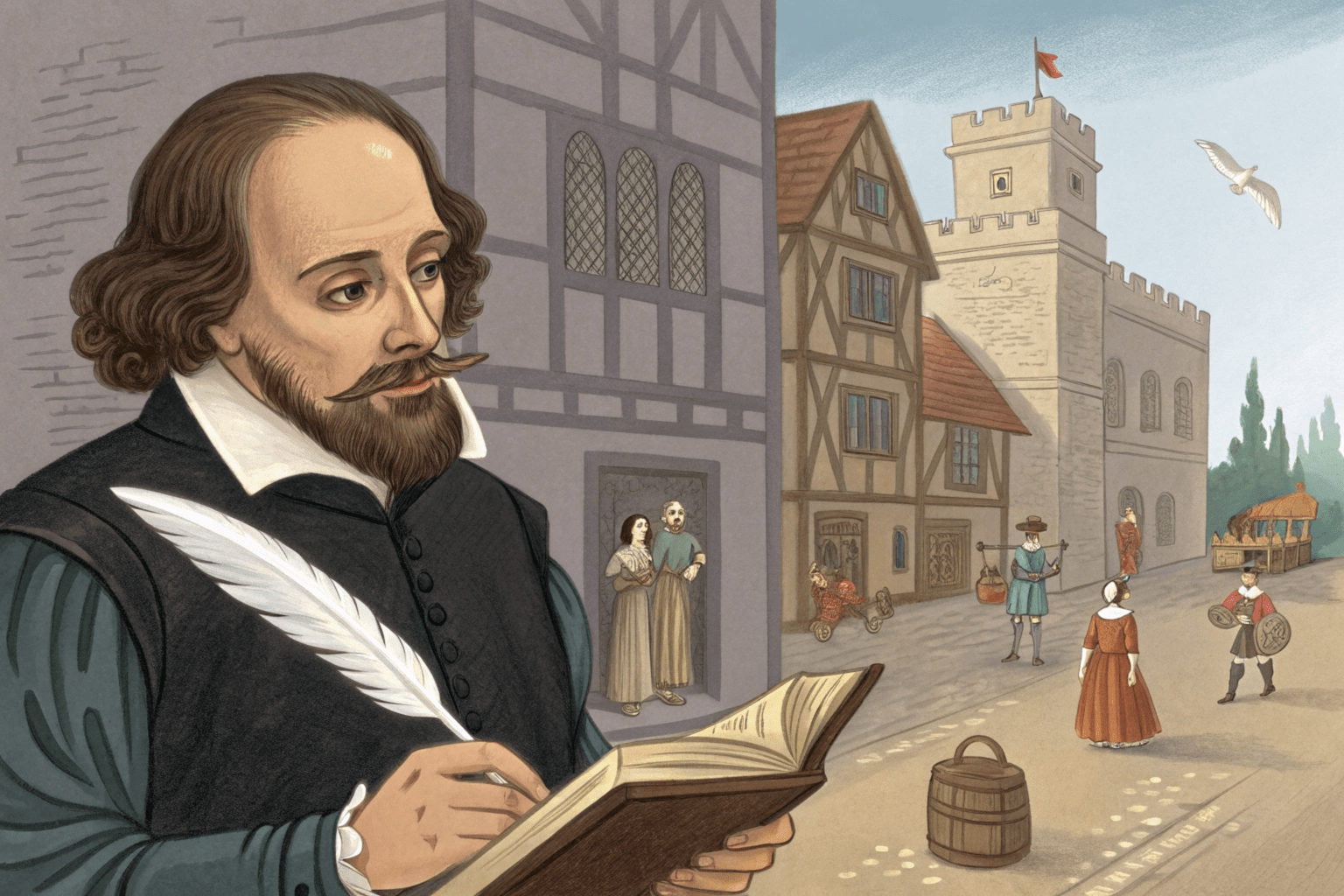
Goal: In this lesson, you will explore the life, work, and legacy of the most famous playwright of the English language, William Shakespeare. You will also acquire the vocabulary necessary to talk about the topic.
Task 1 (Vocabulary)
Practice useful vocabulary on Quizlet. You may need to register for full access.
- Click HERE for the English-English vocabulary list
- Click HERE for the English-Norwegian vocabulary list
Other languages:
Click HERE for the English-Arabic vocabulary list
Click HERE for the English-Tagalog vocabulary list
Click HERE for the English-Kinyarwanda vocabulary list
Click HERE for the English-Ukrainian vocabulary list
Click HERE for the English-Russian vocabulary list
Click HERE for the English-Arabic vocabulary list
Click HERE for the English-Tagalog vocabulary list
Click HERE for the English-Kinyarwanda vocabulary list
Click HERE for the English-Ukrainian vocabulary list
Click HERE for the English-Russian vocabulary list
Task 2 (Brainstorming)
 Answer the questions below and make a mind map based on your answers.
- Who was William Shakespeare?
- What do you know about him?
Task 3 (Video)
Watch our informative video on William Shakespeare and add information to your mind map.
https://vimeo.com/1033626842?share=copy
Task 4 (Reading a Short Text)
Read the text below and do the task under it.
Facts about William Shakespeare
William Shakespeare was born in 1564 in Stratford-upon-Avon, England. He became a successful playwright and actor in London, writing many popular plays that are still performed today.
Did you know?
- Shakespeare married when he was only 18 years old
- He invented over 1,700 new words that we still use
- His shortest play is only 1,787 lines long, while his longest is 4,042 lines
Shakespeare wrote different types of plays:
- Comedies like “A Midsummer Night’s Dream”
- Tragedies like “Romeo and Juliet”
- Histories like “Henry V”
He also wrote beautiful poems called sonnets. In total, Shakespeare created 37 plays and 154 sonnets that we know of.
Shakespeare’s works are famous for their interesting characters, exciting stories, and beautiful language. His plays have been translated into many languages and are performed all over the world.
Even though he lived over 400 years ago, Shakespeare’s stories still speak to us today. They explore timeless themes like love, power, and human nature that we can all relate to.
Task 5 (Reading Comprehension 1)
Choose the correct answer.
Task 6 (Reading a Longer Text)
Preparation
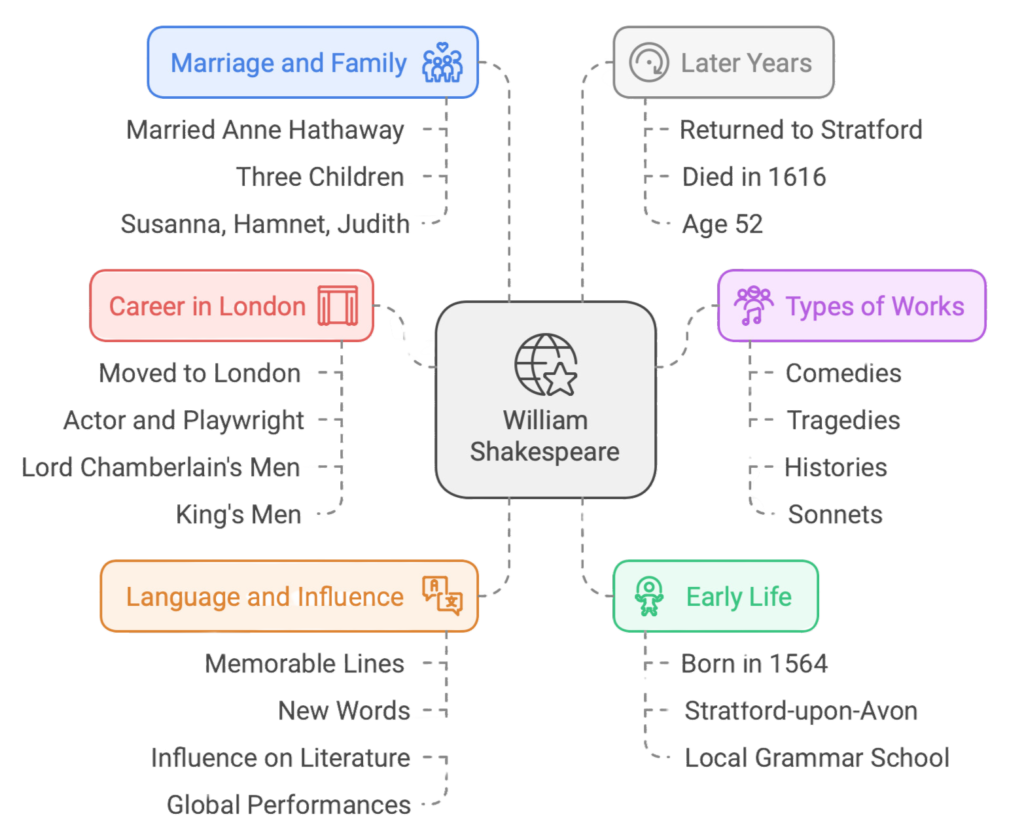
Look at the image below. It is a graphic representation of the longer text you will read.
Answer the following question: What will the longer text deal with?
Reading
Listen to and read the text now. Then, complete the task under it.
William Shakespeare: Life and Legacy
Shakespeare was born in 1564 in Stratford-upon-Avon, England. He grew up in a large family and likely attended the local grammar school. At 18, he married Anne Hathaway, who was 26. They had three children together: Susanna and twins Hamnet and Judith.
In his twenties, Shakespeare moved to London to pursue a career in theater. He became both an actor and a playwright. His plays were very popular, and he soon became successful. Shakespeare worked with a group of actors called the Lord Chamberlain’s Men, which later became the King’s Men.
Shakespeare wrote different types of plays. His comedies, like “A Midsummer Night’s Dream” and “Twelfth Night,” are full of humor and often end with weddings. His tragedies, such as “Romeo and Juliet” and “Hamlet,” tell sad stories about love, death, and power. He also wrote histories about English kings, like “Henry V” and “Richard III.”
Besides plays, Shakespeare wrote beautiful poems called sonnets. He created 154 sonnets that we know of today. These poems often talk about love, beauty, and time.
Shakespeare’s works are famous for their interesting characters and exciting stories. He had a talent for creating memorable lines. Many phrases we use today, like “all that glitters is not gold” and “to be or not to be,” come from his plays.
Did you know that Shakespeare invented many new words? He created over 1,700 words that we still use today. Some examples are “eyeball,” “bedroom,” and “excitement.” He was very creative with language!
Even though Shakespeare lived over 400 years ago, his stories are still popular. They have been translated into many languages and are performed all over the world. His plays explore themes like love, jealousy, ambition, and power that people can relate to even now.
Shakespeare’s influence on literature and language is huge. Many writers, filmmakers, and artists have been inspired by his work. His plays are still studied in schools and universities worldwide.
In his later years, Shakespeare returned to Stratford-upon-Avon. He died in 1616 at the age of 52. Today, millions of people visit his hometown each year to learn more about his life and see where he lived.
Task 7 (Reading Comprehension 2)
Task 8 (Game)
How well do you know Shakespeare’s plays? Click on the picture below and test yourself.
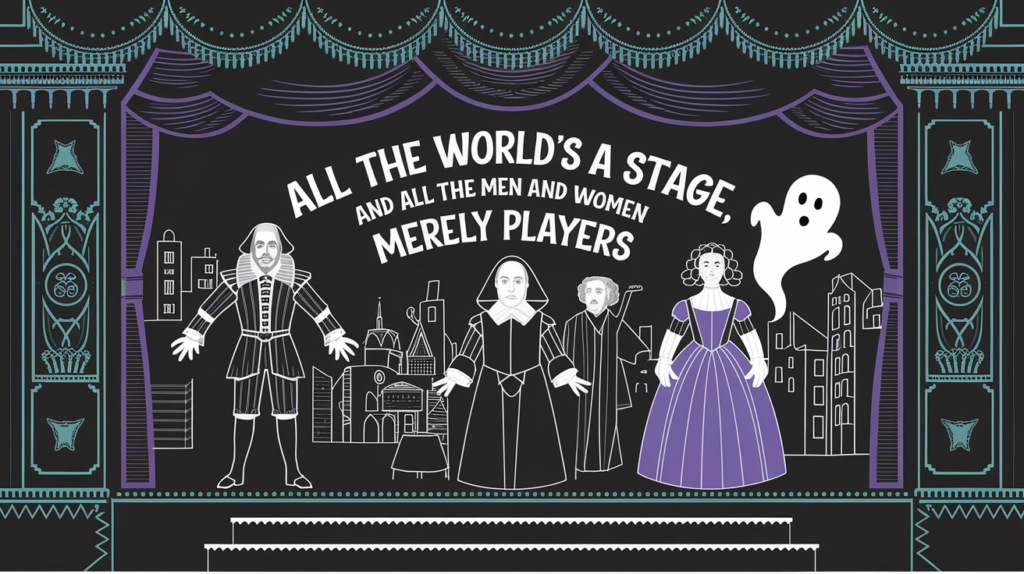
Task 9 (Research)
Below are seven engaging topics for online research on Shakespeare that will help you discover interesting facts about him. You will also find an extended list of topics HERE (the link opens in a new tab).
Choose one topic, research it online, prepare a short presentation, and share your findings with the class.
Suggested link to explore: Shakespeare Birthplace Trust
1
Shakespeare’s mysterious “lost years”
Explore theories about Shakespeare’s life between 1585 and 1592, when there are no records of his activities.
2
The Globe Theatre
Investigate the unique features and history of Shakespeare’s famous theater.
3
Shakespeare’s influence on pop culture
Find references to Shakespeare’s works in modern movies, TV shows, music, and literature.
4
Conspiracy theories about Shakespeare’s identity
Look into claims that Shakespeare didn’t write his own plays and the proposed alternative authors.
5
Shakespeare’s family life
Research Shakespeare’s relationships with his wife, children, and parents.
6
Shakespeare’s sonnets
Investigate the structure, themes, and mysteries surrounding Shakespeare’s 154 sonnets.
7
Shakespeare around the world
Discover how Shakespeare’s works have been adapted and performed in different cultures and languages.
1
Shakespeare’s mysterious “lost years”
Explore theories about Shakespeare’s life between 1585 and 1592, when there are no records of his activities.
2
The Globe Theatre
Investigate the unique features and history of Shakespeare’s famous theater.
3
Shakespeare’s influence on pop culture
Find references to Shakespeare’s works in modern movies, TV shows, music, and literature.
4
Conspiracy theories about Shakespeare’s identity
Look into claims that Shakespeare didn’t write his own plays and the proposed alternative authors.
5
Shakespeare’s family life
Research Shakespeare’s relationships with his wife, children, and parents.
6
Shakespeare’s sonnets
Investigate the structure, themes, and mysteries surrounding Shakespeare’s 154 sonnets.
7
Shakespeare around the world
Discover how Shakespeare’s works have been adapted and performed in different cultures and languages.
Task 10 (Shakespeare’s Contribution to Language)
Below is a list of some famous phrases coined by Shakespeare, along with their meanings in today’s English.
Choose at least five phrases and learn them by heart. Then, write a short text or sentences where they are used.
All that glitters is not goldMeaning: Appearances can be deceiving; not everything that looks valuable is actually valuable.The Merchant of VeniceBreak the iceMeaning: To initiate social interaction or conversation, especially in a stiff or formal setting.The Taming of the ShrewWear one’s heart on one’s sleeveMeaning: To openly display one’s emotions or feelings.OthelloWild goose chaseMeaning: A foolish and hopeless pursuit of something unattainable.Romeo and JulietThe green-eyed monsterMeaning: Jealousy personified.OthelloIn a pickleMeaning: In a difficult or uncomfortable situation.The TempestForegone conclusionMeaning: An inevitable result; a predetermined outcome.OthelloThe be-all and end-allMeaning: The most important or essential factor; the central or crucial element.MacbethBrave new worldMeaning: A new and hopeful period in history resulting from major changes in society.The TempestEaten me out of house and homeMeaning: To consume all of someone’s food or resources.Henry IV, Part IINeither rhyme nor reasonMeaning: Without logic or sense.As You Like ItMum’s the wordMeaning: Keep quiet; don’t say anything about this.Henry VI, Part IIThe world is my oysterMeaning: One has the ability and opportunity to profit from the world as one pleases.The Merry Wives of WindsorKnock knock! Who’s there?Meaning: The start of a common joke format.MacbethDead as a doornailMeaning: Completely and utterly dead.Henry VI, Part II
Click HERE to view the full list of phrases. NOTE: The link opens in a new tab.
Task 11 (Talking about Shakespeare)
Using the diagram below, tell your study partner what you have learned about William Shakespeare.
Alternatively, you can ask each other questions about Shakespeare based on the diagram and answer them.